
Science Reading That Builds Knowledge and Writing Skills: Plant Structures

Science instruction gives students the opportunity to learn about the world around them, but it also provides a powerful opportunity to strengthen reading and writing skills.
That’s why I’m excited to introduce a new 3rd–5th Grade Science Reading & Writing Series designed to combine science content, reading comprehension, vocabulary, note-taking, and writing practice in one cohesive resource.
The first resource in the series is now available: Plant Structures.

Why Combine Science and Literacy?
Students don’t learn science only by doing experiments. They also learn science by reading, talking, taking notes, explaining ideas, and writing about what they know. Learning about science also increases students' reading comprehension because reading comprehension becomes stronger when students have knowledge about the topic they are reading. This series is designed around that connection.

Each science passage gives students an opportunity to build content knowledge and vocabulary while practicing the literacy skills they need to become stronger readers and writers. Rather than treating reading and writing as separate from science, these activities make literacy part of the science lesson or science a part of a literacy lesson.
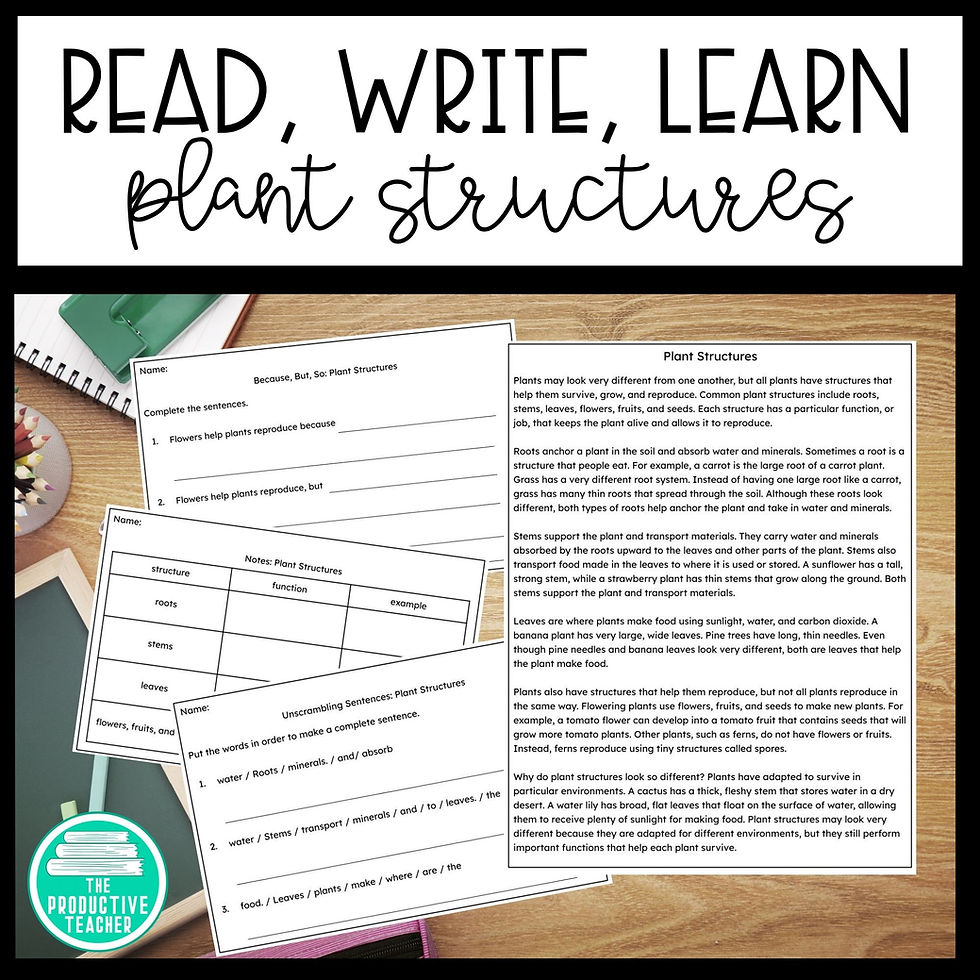
The Plant Structures Reading Passage
The first passage in the series focuses on plant structures and their functions. Students learn about important plant structures, including roots, stems, leaves, flowers, fruits, and seeds, and explore how these structures help plants survive and reproduce.
The passage is written for students in grades 3–5 and can be used as a science reading activity, a source of information for a science unit, or additional practice with informational text.
But the reading passage is only the beginning.
More Than a Reading Passage
Each passage in the series includes a consistent set of activities that allow students to interact with the content in several different ways.
🌱 Vocabulary Review
Students review important science vocabulary from the passage. Vocabulary isn't just something students need to memorize for a quiz. Students need opportunities to see, use, and connect new words to meaningful content. The vocabulary activities help students become more familiar with the academic and science-specific language they will encounter in the passage and in their own writing.
✏️ Three Writing Activities
Each passage also includes three writing activities based on concepts from The Writing Revolution that use the science content as the foundation for sentence-level writing practice. Students might work with sentence structure, combine ideas, expand sentences, or manipulate sentences while thinking about the science concepts they have just learned.
Students shouldn't have to choose between learning science and practicing writing. They can do both at the same time.
The activities provide structured practice with syntax and sentence construction while reinforcing the content from the passage.
📝 Notes Page
Students also have a notes page to record important information from their reading. Taking notes gives students practice identifying and organizing the most important information in an informational text.
It also creates a useful resource they can return to when they are ready to write.
Building Toward Longer Writing
One of my favorite parts of this series is that the passages aren't designed to be isolated activities.
As the series grows, groups of related passages will provide the content knowledge and source material students need for larger writing assignments. For example, students may read several passages about different aspects of a science topic, take notes, review vocabulary, and practice writing sentences about what they have learned. Then they can use that knowledge to write a paragraph, constructed response, or longer science essay.
Instead of asking students to write about a topic before they have developed enough knowledge to say something meaningful, the reading passages help build the knowledge and vocabulary they need first.
Designed for the 3rd–5th Grade Classroom
The goal of this series is to make it easier to integrate science and literacy without creating a completely separate lesson for every skill.

You can use the resources in a variety of ways:
as part of your regular science instruction
for independent reading
during science centers
for small-group instruction
as science reading homework
for early finishers
as review before an assessment
as writing preparation
as part of an integrated science and literacy block
The consistent format also makes it easy for students to become familiar with the routine as you move through different science topics.
The First Resource Is Here!
Plant Structures is the first reading passage in the new series, and I’m excited to continue adding passages throughout the year.
Each passage will be available individually, so you can purchase only the topics you need. As more resources are released, related passages will also be bundled together to make it easier to build a complete science reading and writing collection.
If you're looking for a way to build science knowledge while giving your students meaningful practice with reading, vocabulary, note-taking, and writing, I hope you'll give the first resource a try.
🌱 Get the Plant Structures Reading Passage
And be sure to check back as the series grows! More 3rd–5th grade science reading passages, vocabulary activities, Writing Revolution activities, notes pages, and extended writing assignments will be coming soon.


Comments